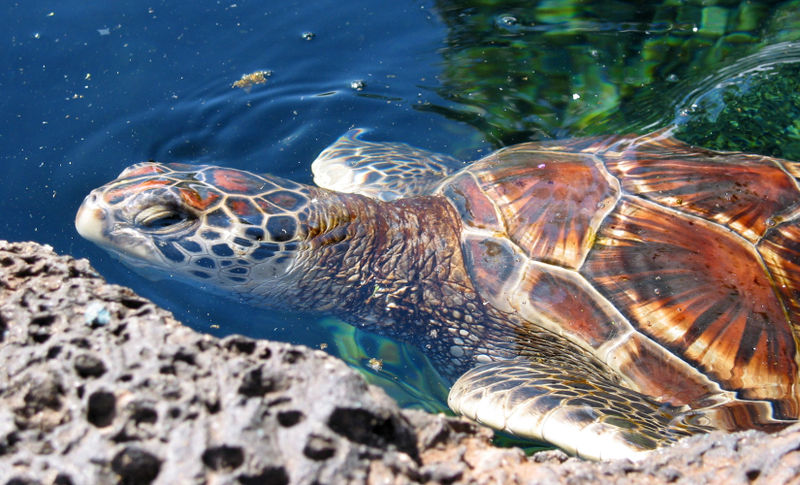
 The Green Sea Turtle, Chelonia Mydas is listed under Appendix I of CITES (Convention on International Trade in Endangered Species). This means that if you were an animal species listed under this particular category, you're royally screwed. Only animal species which are critically endangered and about to be buggered are placed under the 1st Appendix. You are allowed certain protection once you're under the 'about to be buggered' category though, as those pesky human gits are only allowed to trade, either you or any of your species only in exceptional circumstances. This basically means that there shall be no trade (read: capturing you in the wild and sticking you in their backyard) of your species (egss included) whatsoever, unless of course some of those gits are conducting scientific research on you.
 Life for a sea turtle nowadays look pretty bleak. Not only there are threats to the species' survival like habitat destruction on their beaches, being accidentally tangled in fisherman’s nets, some wanker poaching their eggs, trash pollution in the oceans and getting whacked by muppets on watercrafts. Then there is also the danger of artificial lighting on nesting beaches, which confuses the hatchlings and lures them toward roads instead of toward the sea where they should go.
Again, if you were one of the Chelonia species, it would take you about 30 years to mature. 30 loooong years, or about 7 world cups to pass before (if you're a hot chicas adult female sea turtle) to return to the same beach from which you hatched originally to lay your eggs. Furthermore, this can take place every two to four years in maturity which produces on average about four to seven nests per nesting season. Being a little juvenile turtle is no easy kickabout in the park either. Your mortality rate is very high as only, at most, 1 in 100 of you will be successful in making it to adulthood. Shite, half your siblings would get picked off one by one from the sand by seagulls as they try to reach the ocean after hatching. Then there's sharks and morays and whatever else is waiting to gobble you up in the ocean.

SEATRU (our local Sea Turtle Research Unit based in Redang) reports that the nesting density for green turtles in Terengganu showed year to year fluctuations. Average annual nestings shows a decline of almost 62% from 10 year ago. Nonetheless, the size of the green turtle population in Terengganu is the most significant, compared to the other species.
Therefore, it was only apt that last week, during my honeymoon-cum-dive trip, we were holed up at Turtle Beach in Pulau Perhentian, a secluded yet quaint stretch of beach overlooking a little cove. The beach is in actual fact gazetted as a turtle nesting site by Marine Parks and yet a resort had been in operation for the last 2 years. Another proof of government apathy at its best. Considering that it was not the operator’s entire fault as they were not informed by the government of the gazette, they are now working closely with SEATRU on how best to mitigate the risks.
Marine Parks had even opened up a turtle hatchery site on the other side of the island and so each night, some of their staff patrol the beach to collect and transfer the eggs to the assigned site for better protection against poachers and predators.
However, even with the strict efforts done by the respective government agencies and NGO alike, there were still incidents which showed that turtle conservation in Malaysia has a long way to go.
Case #1.
On the first night at about 11pm, we heard the unmistakable sound of a Chelonia dragging its heavy body up the beach. She was huge, the snout-to-vent length alone was about 1 metre. The width was half of that. We spied it from afar. No lights and no sound.
Together with the Marine Parks staff, we tried as best as we could to cordone the area off in order to give the animal some personal space. Since poaching is still a major problem even with the existing regulations, we had swept the beach to hide the tracks of the turtle. (Poachers spotlight the beaches to look for tracks which would indicate a turtle landing had taken place.).
Then came the problem. During the nesting, a boat operator from the local village came in with a boatload of tourists and started to converge on the nesting site. The culprit who had brought in the tourist was a local, much influential it seemed as the Marine Parks staff didn’t dare to raise a finger to stop him. Stopping short of getting into a fight with the Wanker, I tried to explain how disturbing a nesting mother would deter it from ever landing on the beach for nesting ever again. My argument fell on deaf ears. They had surrounded the poor creature and were taking pictures of her, flashes and all.
Case #2.
Whilst in Kuala Terengganu, the Missus wanted to visit the local flea market to do a bit of shopping, and there, even with strict CITES guidelines and Fisheries legislation, were rows upon rows of turtle eggs, being openly and blatantly sold.
In conclusion, common sense and logic dictates it simply that if an animal is being threatened by extinction, the best thing that people can do is to stop all activities which can reduce its population even further. It was fortunate enough that the nesting mother was able to finish the job and return to sea, even with a bloody mob around her. I mean, you wouldn’t like it if someone stuffed a bloody camera up your arse while you’re giving birth, would you? Will you return to the same bloody hospital for your 2nd birth? I should think not.
Consuming the eggs of an endangered species wouldn't help it's critical situation either. it's not like it tastes good anyway, very bland and minging (hey, I was 6 years old). Remember, stop the demand and the supply will follow suit too.